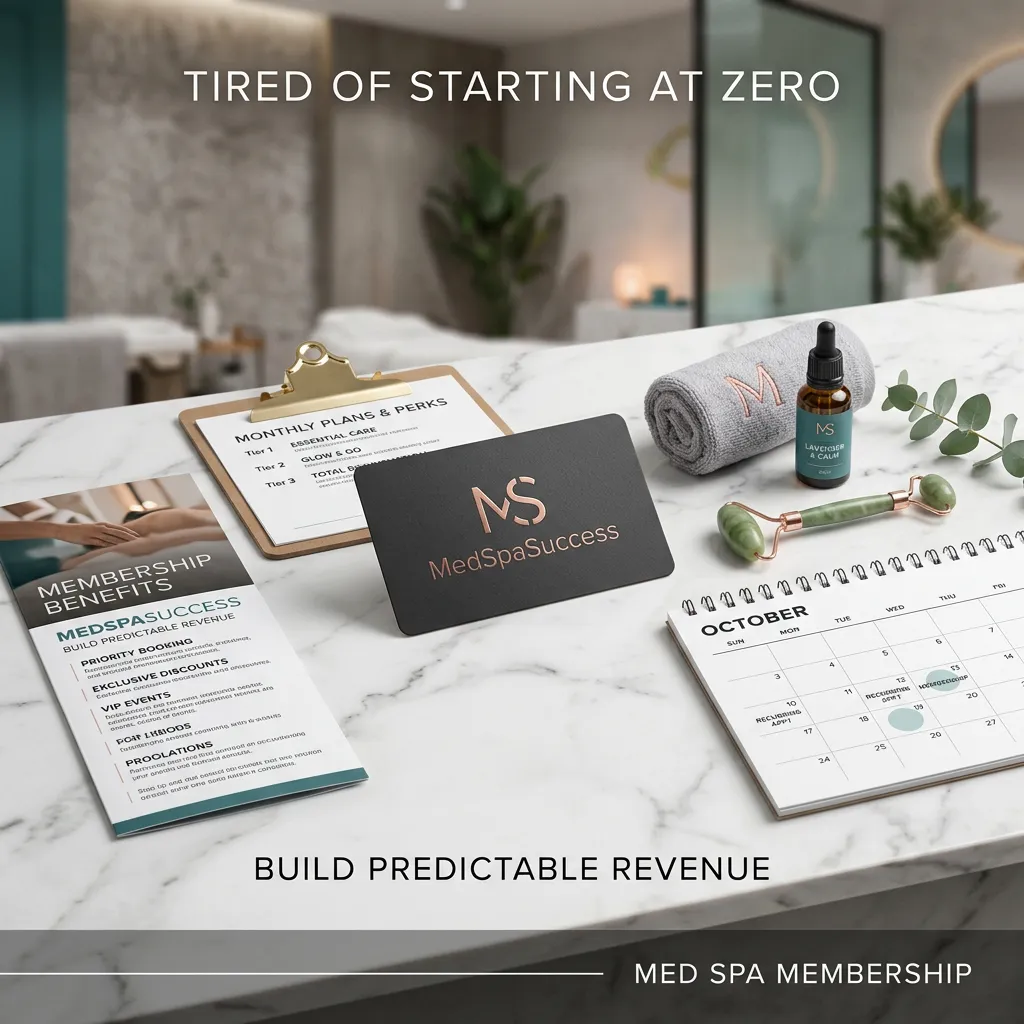
Med spa membership programs
How to Build a Med Spa Membership Program That Creates Predictable Recurring Revenue
If the first of every month makes your stomach drop a little, you're not alone.
Most med spa owners I work with have the same pattern. A great month, then a slow one. A packed schedule in November, then a January so quiet you start wondering if you should run another sale. You're always chasing the next client because last month's revenue doesn't carry over.
That's not a marketing problem. It's a model problem. And the fix is one of the most powerful tools in this industry: a well-built membership program.
When I built Admire Aesthetics to seven figures in two years, recurring revenue was the backbone. It's what let me hire ahead of growth, open a second location, and eventually sell the business. Buyers don't pay for busy. They pay for predictable.
Here's how to build a membership that actually works.
Why memberships matter more than another promotion
A promotion brings people in once. A membership brings them back on a schedule.
That matters because most aesthetic results depend on consistency. Neurotoxin wears off. Skin needs ongoing care. Clients who come in regularly get better results, and clients who get better results stay, refer, and spend more over time.
A membership also flips your monthly math. Instead of starting at zero, you start with a base of revenue already on the books. That changes how you staff, how you plan, and how you sleep.
Step 1: Decide what problem the membership solves
The biggest mistake I see is building a membership around what's convenient for the spa instead of what the client wants.
"$99 a month for 10% off" isn't a membership. It's a discount with a billing date.
Start with your best clients. What do they come in for most? What do they wish they could do more often? Build the membership around a result, like maintaining their skin, staying ahead of lines, or keeping a monthly self-care ritual.
Step 2: Build tiers around real client behavior
Two or three tiers is plenty. More than that creates decision fatigue.
A simple structure that works for many practices:
Essentials: one monthly facial-level treatment plus member pricing on products.
Signature: a higher-value monthly treatment (peel, microneedling, or advanced facial) plus member pricing on injectables.
Elite: banked credit toward any service, priority booking, and member-only event access.
Price each tier so the monthly fee covers your cost of delivery with healthy margin. Then let the member perks do the heavy lifting on perceived value.
Step 3: Make the value obvious, not the discount
Clients don't join memberships to save money. They join to feel taken care of.
Lead with what they get: priority booking, a personalized treatment plan, member-only events, a birthday gift, a provider who knows their face. The savings are a bonus, not the headline.
This is where most spas undersell. When your front desk says "it saves you 15%," the client does math. When they say "you'll never have to wait for an appointment again, and your provider builds your plan around you," the client feels something.
Step 4: Protect the program with clear terms
A membership without structure turns into a headache fast. Decide up front:
Commitment: a 6- or 12-month minimum keeps members long enough to see results.
Rollover rules: whether unused credits roll over, and for how long.
Cancellation: notice period and any fees, stated in writing.
Freeze policy: what happens if someone travels or has a health event.
Put it all in a simple agreement and review it with every new member. Clear terms prevent awkward conversations later.
Step 5: Train your team to offer it every time
Your membership only works if people hear about it.
The best moment to offer a membership is at checkout, right after a great treatment, when the client is feeling the result. Build it into your consultation and checkout scripts so it's a natural recommendation, not a pitch. (If "selling" makes your team uncomfortable, start with our post on turning consultations into clients without feeling like a salesperson.)
Track how many eligible clients hear the offer each week. You'll be surprised how many never do.
Step 6: Automate billing and retention
Use your CRM or practice software to handle recurring billing, failed-payment reminders, and appointment nudges automatically. A member who hasn't booked in 30 days should get a friendly reminder before they start feeling like they're paying for nothing.
That unused-membership feeling is the number one reason people cancel. Automation catches it early.
What a healthy membership program looks like
You'll know it's working when:
A growing share of your monthly revenue is recurring.
Members book on a regular rhythm without being chased.
Your cancellation rate stays low after the first few months.
Members spend more on add-ons and retail than non-members.
The bottom line
Pretty doesn't pay. Predictable does.
A membership program turns your best clients into the foundation of your business. It gives you steady cash flow, better client results, and a practice that's worth more if you ever decide to sell.
If you want help designing a membership that fits your services, pricing, and team, that's exactly what we build inside MedSpa Evolution. Join the Evolution or book a strategy call and let's map it out together.
FAQ
How much should a med spa membership cost? Most med spa memberships fall between about $79 and $299 a month depending on the treatments included. Price each tier so the monthly fee covers your cost of delivery with margin, then add perks that raise perceived value without raising your cost.
Do med spa memberships actually increase revenue? Yes, when they're built around client results instead of discounts. Members visit more consistently, spend more on add-ons, and stay longer, which raises lifetime value and smooths monthly cash flow.
Should a membership require a contract? A 6- or 12-month minimum is common and helps members stay long enough to see results. Clear written terms for cancellation, rollover, and freezes protect both you and the client.
What's the difference between a membership and a package? A package is a one-time purchase of a set number of treatments. A membership is recurring, renews automatically, and includes ongoing perks, which makes it a continuity tool rather than a single sale.